
Fiorenzo Ranieri
On 10 October 2026, as part of the training activities organised by the Martha Harris Association for Psychoanalytic Psychotherapy with Children and Adolescents (Associazione Martha Harris di Psicoterapia Psicoanalitica per l’Infanzia e l’Adolescenza), Professor Anna Maria Speranza gave a seminar devoted to silent distress in adolescence.
This article offers a reworking of the material presented and discussed by the speaker, preserving its theoretical perspective, principal clinical references, and implications for psychopathological assessment. It is not a transcript of the seminar, but a considered reconstruction of its main themes, organised in a discursive form to facilitate reading and consultation.
The seminar addressed a question of particular clinical importance: how can we recognise and understand forms of adolescent suffering that may remain unnoticed for a long time because they do not manifest themselves through overtly conflictual or transgressive behaviour?
Distress That Goes Unnoticed
Adolescence involves a profound reorganisation of identity and of the individual’s relationship with their body, family, and external world. Physical and sexual changes, the development of cognitive capacities, and the gradual movement towards autonomy require a redefinition of self-image and established patterns of relating to others.
In this process, adolescents must confront new and unfamiliar aspects of their experience. The self, which had achieved a degree of relative stability during childhood, once again becomes an object of observation, questioning, and judgement. The opportunity to explore the world and develop an individual identity is therefore accompanied by increased exposure to the gaze of others.
Shame, feelings of inadequacy, fear of failure, and sensitivity to judgement acquire particular significance. They are not necessarily pathological manifestations: they may be part of the normal fluctuations of adolescence. They become clinically relevant when they persistently restrict opportunities for experience, relationships, and development.
Some forms of adolescent suffering are expressed through opposition, transgression, emotional dysregulation, or impulsive behaviour. Others take a less visible form, characterised by inhibition, withdrawal into oneself, and a progressive reduction in emotional and relational investments.
It is these latter forms that are referred to as silent distress.
Silent distress is not an independent diagnostic category, but rather a way in which psychological suffering manifests itself, with distress predominantly directed inward. An adolescent may appear quiet, compliant, responsive to family and school expectations, and sometimes even particularly efficient. Yet behind this apparent normality, a progressive impoverishment of subjective experience may develop.
Overadaptation is one of its most significant manifestations. A young person who causes no problems, achieves good results, and consistently meets expectations may pay a considerable psychological price to maintain an acceptable image of themselves. The fear of disappointing others, failing, or being exposed to judgement may gradually replace curiosity, desire, and the pleasure of exploration.
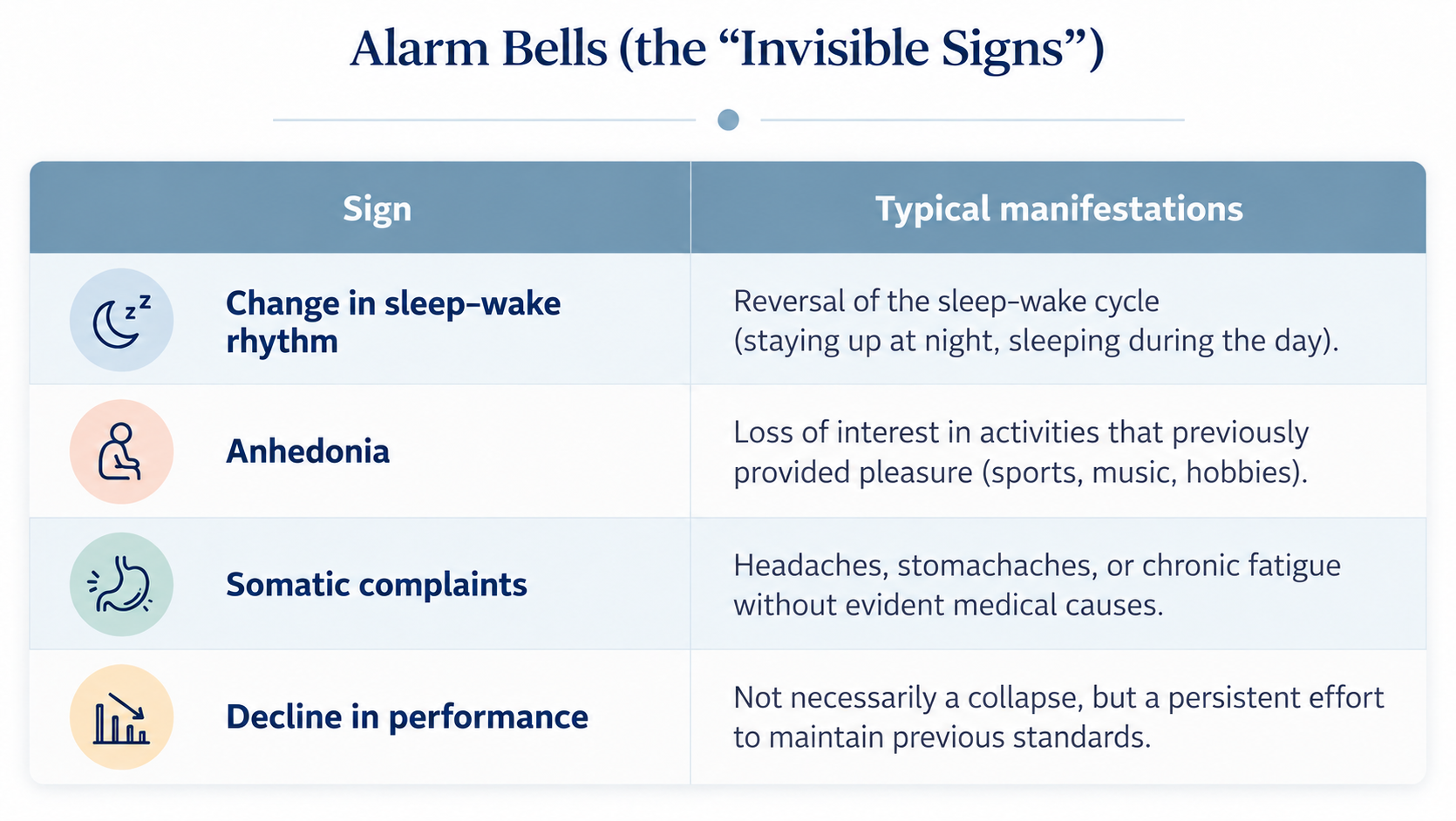
Less obvious signs include changes in the sleep–wake cycle, loss of interest in previously rewarding activities, somatic complaints, and increasing difficulty in maintaining habitual levels of performance.
A marked decline in school achievement or social functioning does not always occur: sometimes outward functioning remains intact, but requires an ever-increasing effort.
The clinical significance of these signs depends above all on their relationship to the adolescent’s developmental history, their duration, and the progressive restriction of opportunities for living and experiencing.
Inhibition, Anxiety, and Defensive Function
An important theoretical reference is Freud’s Inhibitions, Symptoms and Anxiety (1926).
Inhibition, as distinct from a symptom, involves the restriction of an ego function.
A person may give up an activity to avoid a conflict, to protect themselves against an increase in anxiety, or because a substantial proportion of their psychological resources is devoted to maintaining defensive processes.
In adolescence, this perspective invites us to question the meaning of behaviours that might otherwise be interpreted superficially as passivity, lack of interest, or insufficient motivation.
Not participating in an activity, avoiding a relationship, giving up an experience, or being unable to make a decision may all represent ways in which the individual attempts to protect themselves against an emotional threat.
Such renunciation may be associated with intrapsychic conflict, but also with a threat to self-esteem and to the continuity of the sense of self.
In the latter case, the adolescent does not simply fear failure: they fear that failure will confirm a fundamental sense of personal inadequacy.
A clinical understanding of inhibition therefore requires consideration of which function is being restricted, what anxiety may be avoided through renunciation, and what consequences this has for development.
A circumscribed inhibition may have a very different meaning from a progressive restriction of experience in which emotional investments, relationships, and even the capacity to desire are sacrificed.
Social Withdrawal and Isolation: The Case of Hikikomori
One of the most evident expressions of silent distress is social withdrawal, which may vary considerably in severity, ranging from reduced social contact to extreme forms of isolation.
The phenomenon of hikikomori represents one of the most severe and persistent configurations of social withdrawal. Although it shares important features with social anxiety, it cannot automatically be reduced to a single psychopathological category.
Socially withdrawn adolescents may experience anxiety, depression, apathy, disturbances of the sleep–wake cycle, obsessive-compulsive symptoms, difficulties in emotional regulation, and, in some cases, more severe psychopathological experiences.
Sometimes withdrawal is preceded by satisfactory school and social functioning; in other cases, it emerges against a background of difficulties already present in childhood.
The distinction between primary social withdrawal and withdrawal secondary to other psychopathological conditions is therefore important, although it is not always easy to establish.
From a psychodynamic perspective, the concept of psychic retreats, described by John Steiner (1993), makes it possible to consider withdrawal as a potential defensive organisation.
Adolescents may construct a protected space in which they can escape relational experiences perceived as intolerable. Isolation reduces exposure to shame, judgement, and frustration, offering a sense of control and relative safety.
This protection, however, may come at a considerable developmental cost. Progressive withdrawal from relationships limits opportunities for encountering others, hinders the development and testing of new capacities, and may contribute to the increasing rigidity of defensive patterns.
The seminar also referred to certain family configurations that may accompany these conditions.
In particular, the narcissistic idealisation of a child may make failure and disappointment difficult to tolerate. In other circumstances, growth and autonomy may be experienced as threats to the family’s equilibrium, encouraging the maintenance of infantile positions.
These configurations should be regarded as possible elements in clinical understanding, not as generalisable causal explanations.
The relationship with digital technologies also requires a differentiated assessment. Some withdrawn adolescents make intensive use of video games, social media, and virtual environments, whereas others use them only to a limited extent.
Digital environments may reinforce avoidance, but they may also represent one of the few remaining opportunities for contact with the external world.
Obsessive Features, Perfectionism, and Control
Silent distress may also manifest itself through obsessive patterns that do not necessarily amount to a fully developed obsessive-compulsive disorder.
During adolescence, the pursuit of control may represent an attempt to contain anxiety associated with changes in the body, identity, and relationships.
Academic perfectionism, excessive concern with body image, control over eating and physical activity, rigid habits, and reliance on rituals may serve a protective function against feelings of uncertainty and inadequacy.
Under these circumstances, control does not necessarily expand the individual’s capacity for action; on the contrary, it may restrict it.
An adolescent may spend a disproportionate amount of time preparing an assignment, repeatedly rewrite notes, postpone an examination because they do not feel sufficiently prepared, or abandon an activity for fear of being unable to perform it perfectly.
Perfectionism may therefore lead to procrastination and decisional paralysis.
A particularly important role is played by repetitive worry and rumination, understood as recurrent mental activity that is difficult to control.
Adolescents may endlessly revisit conversations, mistakes, and embarrassing situations, or anticipate future scenarios involving failure and rejection.
Unlike reflection that allows experience to be processed, circular thinking tends to reproduce the same content repeatedly without generating new possibilities for understanding or action.
Mental activity may become a way of avoiding contact with emotions that are difficult to tolerate. Continuous thinking temporarily replaces the possibility of feeling, choosing, and acting.
Here too, the diagnostic question is not merely to identify obsessive symptoms, but to understand their function within the adolescent’s overall mental organisation.
The Childhood Roots of Silent Distress
A particularly significant aspect of the seminar concerned the possibility of identifying certain precursors of adolescent difficulties during childhood.
Inhibition, shyness, fear of novelty, and withdrawal may be observed early in development, but they do not necessarily indicate future psychopathology.
Some children display particular sensitivity to unfamiliar stimuli, difficulties with exploration, a heightened need for protection, and a tendency to withdraw from unfamiliar situations.
These characteristics may diminish over the course of development, or persist and assume different forms.
The longitudinal research by Eggum and colleagues (2009), discussed during the seminar, provides an important illustration of the heterogeneity of developmental trajectories.
The study, conducted with a non-clinical sample of 214 children across four successive assessments, identified different patterns of social withdrawal: initially low and decreasing levels, initially high and decreasing levels, moderate and stable levels, and moderate but increasing levels.
A particularly interesting finding is that initially high levels of withdrawal may decrease over time, whereas initially moderate withdrawal may progressively intensify.

Risk assessment cannot therefore be based exclusively on the severity of manifestations observed at a single point in time. It is necessary to consider the direction of change and the relationship between individual characteristics and environmental experiences.
Research on psychopathological continuity also distinguishes between homotypic continuity, when similar manifestations persist across different developmental stages, and heterotypic continuity, when an underlying vulnerability is expressed through different clinical presentations over the course of development.
Early inhibition may therefore remain relatively stable or develop into anxious, depressive, avoidant, or obsessive manifestations.
These are not inevitable outcomes, but developmental possibilities that depend on the interaction between temperamental characteristics, relationships, experiences, and individual resources.
This perspective makes it particularly important to reconstruct the developmental history of the child or adolescent, rather than interpreting current manifestations as isolated phenomena.
From Symptoms to Mental Functioning: The Contribution of the PDM-3
One of the central themes of the seminar was the need to distinguish observable behaviour, symptomatic manifestations, mental functioning, and personality organisation.
Two adolescents who display apparently similar forms of social withdrawal may have profoundly different subjective experiences and patterns of mental functioning.
In one case, the desire for relationships may predominate, accompanied by fear of judgement and rejection.
In another, detachment may be associated with more profound difficulties in representing others, experiencing intimacy, and integrating affects.
The psychodynamic assessment proposed by the Psychodynamic Diagnostic Manual (PDM-3) makes it possible to consider these differences through the examination of mental capacities, level of personality organisation, and emerging personality styles.
The MA Axis considers thirteen mental capacities, grouped into four main domains: affective and cognitive processes; identity and relationships; defences and coping; and self-awareness and self-direction.
Among the dimensions considered are affect regulation, mentalisation, bodily experience and representation, differentiation and integration of representations of self and others, self-esteem regulation, the capacity for trust and intimacy, defensive functioning, resilience, and the sense of agency.
Assessment of these capacities makes it possible to understand not only the severity of difficulties, but also the resources available and potential therapeutic indications.
Mentalisation, reflective functioning, and the capacity to recognise and represent one’s own and others’ mental states are particularly important.
An adolescent may be able to describe their activities and symptoms in considerable detail while experiencing significant difficulties in recognising the affects accompanying those experiences or attributing meaning to the behaviour of people with whom they interact.
The capacity for agency, understood as the ability to experience oneself as the subject of one’s own actions, represents another particularly significant dimension.
The progressive restriction of initiative and the capacity to make choices may be one of the most disabling aspects of silent distress.
Alongside the assessment of mental capacities, the PDM-3 considers the level of emerging personality organisation and different personality styles.
For internalising manifestations, depressive, anxious-avoidant and phobic, schizoid, and obsessive-compulsive configurations are particularly relevant.
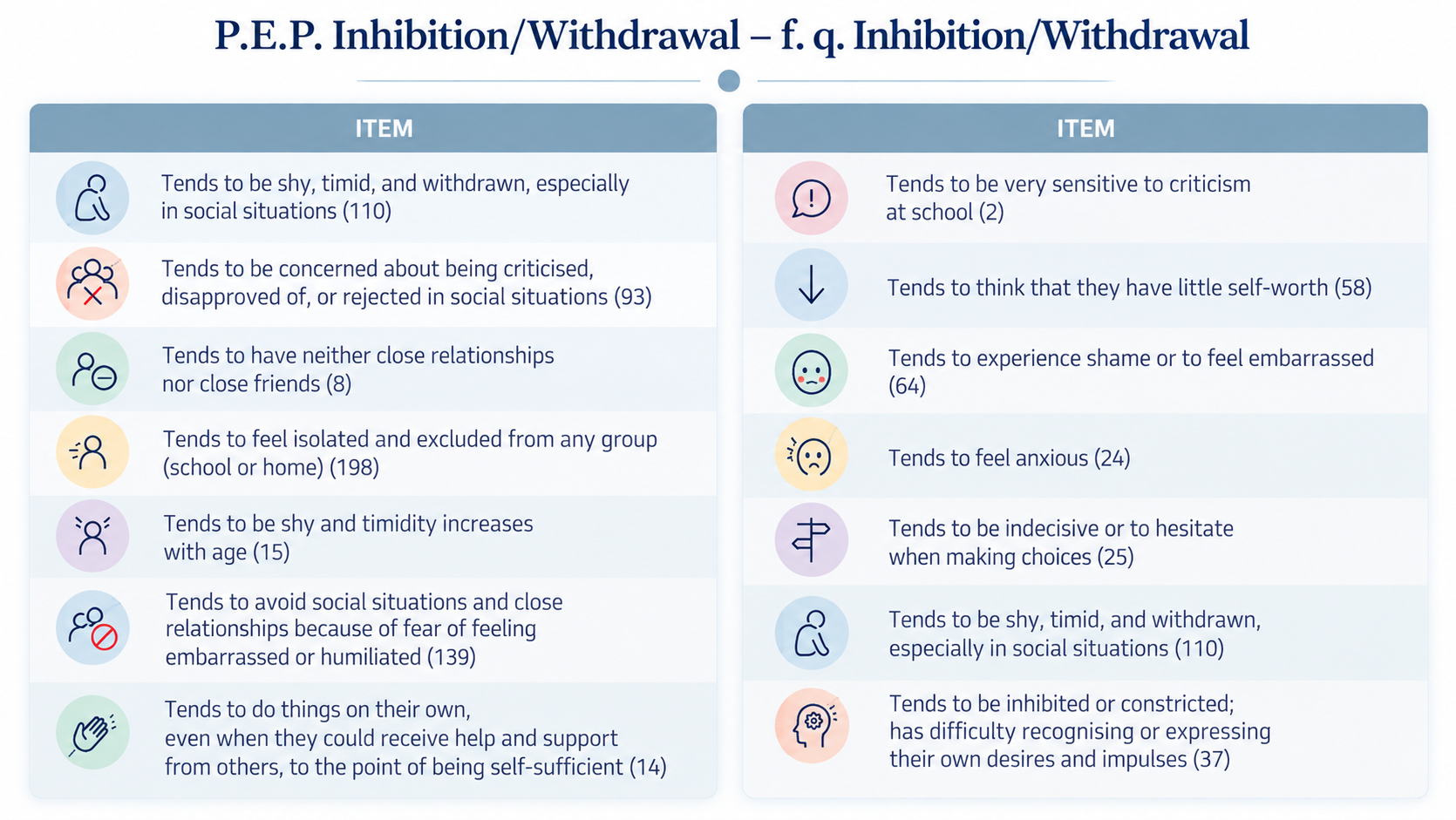
In emerging anxious-avoidant personality patterns, shame, inadequacy, sensitivity to criticism, and fear of rejection predominate. The desire for relationships may be intense, yet accompanied by a need to withdraw from situations in which the individual feels exposed.
In emerging schizoid configurations, detachment, difficulties with intimacy, restricted affective expression, feelings of estrangement, and distinctive ways of organising experience may be more prominent.
In obsessive patterns, by contrast, control, rigidity, attention to detail, perfectionism, and difficulty tolerating uncertainty or imperfection predominate.
These descriptions should not be used to assign premature personality diagnoses to children and adolescents. Rather, they help identify relatively stable configurations of functioning, taking into account their pervasiveness, rigidity, and interference with development.
Withdrawal, Isolation, and Developmental Risk
The seminar also addressed the relationship between withdrawal, obsessive manifestations, and the possible development of more severe psychopathological conditions, including those characterised by disturbances of thinking and of the relationship with reality.
Loneliness and isolation may already be present in childhood and, over the course of development, may be accompanied by social anxiety, recurrent fears, rumination, depression, and heightened sensitivity to interpersonal experiences.
Adverse experiences such as bullying, discrimination, prolonged family conflict, and violence may intensify feelings of alienation and psychological vulnerability.
It is nevertheless essential to avoid assuming a direct correspondence between social withdrawal and psychosis risk.
Withdrawal may occur within very different psychopathological organisations.
In some circumstances, it primarily constitutes a defence against anxiety and shame; in others, it may be accompanied by a more profound impairment in the capacity to represent experience, distinguish the internal world from external reality, and maintain meaningful relationships.
Assessment must therefore consider the quality of thinking, mentalisation, defensive patterns, the capacity to differentiate self from other, and the integrity of reality testing.
These dimensions help distinguish conditions that may appear very similar at the level of observable behaviour.
The clinical question is not simply how extensively an adolescent withdraws, but what happens to their mental functioning during withdrawal, and what possibilities for relationships and psychological change remain available.
Understanding Silent Distress
The seminar’s principal contribution lies in redirecting attention from the simple description of behavioural manifestations towards an understanding of the mental functioning that underlies them.
The absence of disruptive behaviour cannot be regarded as sufficient evidence of psychological well-being.
An apparently well-adjusted adolescent may experience intense suffering, sustained by considerable defensive effort and accompanied by a progressive restriction of developmental possibilities.
Similarly, social withdrawal, inhibition, and obsessive features do not have a single, unequivocal psychopathological meaning.
Understanding them requires integrating symptom observation with the reconstruction of developmental history, attention to subjective experience, assessment of mental capacities, and examination of family and social relationships.
The distinction between transient manifestations of adolescence and more stable configurations of psychological suffering depends not only on symptom severity, but also on their pervasiveness, the rigidity of defensive processes, and the extent to which opportunities for growth are compromised.
Recognising silent distress therefore means paying attention not only to what adolescents do or do not do, but also to what they progressively become unable to experience, desire, and represent.
References
Eggum, N. D., Eisenberg, N., Spinrad, T. L., Valiente, C., Edwards, A., Kupfer, A. S., & Reiser, M. (2009). Predictors of withdrawal: Possible precursors of avoidant personality disorder. Development and Psychopathology, 21(3), 815–838. https://doi.org/10.1017/S0954579409000443
Freud, S. (1926). Inhibitions, Symptoms and Anxiety. In The Standard Edition of the Complete Psychological Works of Sigmund Freud, Vol. 20. London: Hogarth Press.
Lingiardi, V., & McWilliams, N. (Eds.). (2025). Manuale Diagnostico Psicodinamico. Terza edizione (PDM-3). Milan: Raffaello Cortina Editore.
Steiner, J. (1993). Psychic Retreats: Pathological Organizations in Psychotic, Neurotic and Borderline Patients. London: Routledge.
Note on the Seminar and the Speaker
This article is a reworking of the material presented by Professor Anna Maria Speranza during the seminar Silent Distress in Adolescence, held on 10 October 2026 as part of the training activities of the Martha Harris Association for Psychoanalytic Psychotherapy with Children and Adolescents (Associazione Martha Harris di Psicoterapia Psicoanalitica per l’Infanzia e l’Adolescenza).
The text has been organised and reformulated for study and educational purposes, with the aim of preserving its fundamental theoretical and clinical content.
It is neither a transcript nor a text reviewed or approved by the speaker.
(1) Anna Maria Speranza is a psychologist, psychotherapist, and Full Professor of Developmental Psychopathology in the Department of Dynamic, Clinical and Health Psychology at Sapienza University of Rome. She previously served as Director of the School of Specialisation in Clinical Psychology and as Head of the Department of Dynamic, Clinical and Health Psychology.
Her scientific work focuses primarily on developmental psychopathology, attachment, affect regulation, diagnostic assessment in childhood and adolescence, and the relationships between early experiences and psychopathology. She has contributed to the editorial work on the sections devoted to childhood in the PDM-2 and PDM-3 psychodynamic diagnostic manuals.