MRO for Preadolescents: A Revised Sentence Completion Test


Fiorenzo Ranieri

The MRO Test (Object Relations Model) was published in 1984. It is a test for preadolescents belonging to the family of sentence completion tests. As with other instruments in this category, the subject is asked to complete a series of sentence stems by writing whatever spontaneously comes to mind. The task makes it possible to assess both the explicit content of the responses and the ways in which the subject organises his or her relational world. The test is no longer commercially available, but in my view it continues to be useful for exploring the inner world and relationships of preadolescents. In this post (*) I provide information on the administration and interpretation of the test, an updated version of the questionnaire (LINK) and an Excel spreadsheet to support the interpretation of the data (LINK).

Continue reading MRO for Preadolescents: A Revised Sentence Completion Test

The Hikikomori Body

Fiorenzo Ranieri

Paper presented at the conference “Solitude and Relationships”, organised by the Order of Psychologists of Tuscany on 22–23 January 2026 (proceedings available at:

https://www.fondazionepsicologi.it/quaderni/solitudine-e-relazioni-volume-2/)

Introduction

This contribution offers some reflections on the relationship that adolescents and young adults living in voluntary social withdrawal — commonly referred to in the literature as hikikomori — have with their own bodies. These observations draw on my clinical experience and on findings from the scientific literature. Further valuable insights emerged from the annual seminar The Hikikomori Phenomenon – A Psychoanalytic Perspective on Psychic and Social Withdrawal Across the Life Cycle, organised by the Martha Harris Study Centre in Florence and co-led with Dr Miriam Monticelli.

When we meet adolescents and young adults in social withdrawal, what strikes us is not only their absence from the world, but also a particular mode of bodily presence. The body is there — yet somehow withdrawn, suspended, as though it needed to pass unnoticed. Continue reading The Hikikomori Body

Place Identity: From Traumatic Fragmentation to Reconstruction in Psychotherapy

Fiorenzo Ranieri

Introduction

Places can be understood as contexts of life, concentrations of relationships and social practices, and areas of experience and meaning. In this sense, they influence the way we think, our consciousness, the course of our lives, our social structures, our health, and our well-being.

Place identity, a concept originating in environmental and social psychology (Proshansky et al., 1983), is a component of personal identity that emerges from our relationship with the physical, affective, and symbolic places of our existence. Also referred to as environmental identity (Ranieri, 2022), it is not a fixed map of the world, but rather a subjective geography of the Self, shaped by emotional attachment, loss, and transformation. Place identity is not a linear archive of past places, but a living network that is reactivated through memory, dreams, and play. It provides a relatively stable framework for the elaboration of the Self across different stages of development.

The formation of place identity is not linear, but is instead determined by interweaving connections, discontinuities, and lines of flight; in other words, it develops rhizomatically. In this process of identity formation, places interact with the subject according to a non-hierarchical organisation made up of emotional connections that are often unpredictable. Continue reading Place Identity: From Traumatic Fragmentation to Reconstruction in Psychotherapy

The Denied Body: Clinical and Countertransference Dynamics in Hikikomori Withdrawal

Fiorenzo Ranieri

The article “The Denied Body: Clinical and Countertransference Dynamics in Hikikomori Withdrawal” was published in the March 2026 issue of the Journal of Child Psychotherapy.

Abstract

Social withdrawal, known as hikikomori, represents a complex clinical condition in which the body is often silenced and withdrawn from relational exchange. This paper explores the role of the bodily dimension in psychoanalytic psychotherapy with adolescents and young adults, with particular attention to the therapist’s countertransference reactions. The concept of psychic retreat is used to understand how the body becomes the main vehicle for non-symbolisable communications. Starting from the premise that enactment is the language of the retreat, clinical vignettes illustrate how this process can become a transformative moment when recognised and worked through within the analytic field. The containing function allows the transformation of what has been evacuated into the body into shareable thoughts, thereby reopening a relational space. The paper emphasises the importance of keeping the patient’s body alive in the therapist’s mind, to give meaning to what cannot be said and to restore the possibility of connection with the Other.

Keywords:

Hikikomori; body and psychotherapy; psychic retreat; countertransference; enactment

Ranieri, F. (2026). The denied body: clinical and countertransference dynamics in hikikomori withdrawal. Journal of Child Psychotherapy, 1–16. https://doi.org/10.1080/0075417X.2026.2639574

Indirect Psychotherapy With Parents of Adolescents and Young Adults With Hikikomori

Fiorenzo Ranieri

The journal Psicologia Clinica dello Sviluppo (Il Mulino) published the article “Indirect Psychotherapy With Parents of Adolescents and Young Adults With Hikikomori” in its first issue of 2026 (available in Early Access at the following link: [link]). The pre-print version submitted for peer review is reproduced below.

Abstract:

This article presents a psychodynamic approach to working with families of adolescents and young adults experiencing hikikomori, a specific form of extreme social withdrawal. Young individuals with hikikomori present sensitive challenges for mental health professionals, particularly when they refuse direct contact with clinicians. In such cases, therapeutic work with the parents often becomes the only feasible intervention. The method of indirect psychotherapy is a parent-focused intervention that respects the adolescent’s refusal of treatment while aiming to redefine relational dynamics within the family system. This process seeks to establish an alliance with the parents and gradually engage them in confronting the often idealized yet emotionally neglected internal object of the “child.” When effective, this approach can catalyze meaningful changes in the family and, indirectly, in the adolescent. The article concludes with the presentation of several clinical vignettes.

Keywords: indirect psychotherapy, parent-focused intervention, hikikomori, psychodynamic therapy, psychic retreats Continue reading Indirect Psychotherapy With Parents of Adolescents and Young Adults With Hikikomori

Assessing Trauma: WHOQOL-BREF and WHODAS 2.0 for Adults and Adolescents

Fiorenzo Ranieri

In clinical work with adults and adolescents, one of the main challenges is understanding how a traumatic or excessively distressing event has changed a person’s life. We are not concerned only with symptoms, but with the disruption of existential continuity: relationships, energy, everyday functioning, self-perception, and the capacity to imagine the future.

This change is often silent. It may not emerge during initial clinical interviews and can remain hidden for months, sometimes even years.

Within a psychotherapeutic approach, the clinical interview remains the primary tool for understanding the subjective dimension of trauma, the way in which the person speaks about it (or does not speak about it), the quality of relationships, the bodily and emotional experiences associated with the event, and the capacity to represent it mentally.

The clinical encounter — particularly during adolescence — provides a space in which the therapist can directly observe aspects that no questionnaire can fully capture: emotional fluctuations, defensive patterns, brief episodes of withdrawal, and sudden lapses of attention when a painful memory is approached.

Alongside the clinical interview, however, certain instruments can provide a complementary perspective. They do not replace the therapeutic relationship, but they make it possible to explore areas that often remain obscure because the person does not know how to describe them, does not consider them important, minimises or normalises them, or because they emerge only when investigated through specific questions.

Brief instruments, which can also be administered as semi-structured interviews, allow us to explore — sensitively and using an internationally shared language — the dimensions most affected by trauma: everyday functioning, perceived quality of life, social participation, and the feeling of still being “oneself”. Continue reading Assessing Trauma: WHOQOL-BREF and WHODAS 2.0 for Adults and Adolescents

Borderline Personality Disorder with Severe Functional Impairment in Adolescence

Fiorenzo Ranieri

Fragility and change in borderline adolescence: understanding distress, supporting growth, and fostering continuity of the self.

Borderline personality disorder (BPD) in adolescence is a complex clinical condition, often characterised by intense emotional distress, relational instability, and disorganised behaviour. When personality organisation is associated with low levels of functioning, difficulties manifest themselves with greater intensity and persistence, significantly interfering with the construction of the self, affect regulation, and developmental processes.

Continue reading Borderline Personality Disorder with Severe Functional Impairment in Adolescence

Psychic Withdrawal and Maladaptive Daydreaming in Adolescents and Young Adults

Fiorenzo Ranieri

Psychic withdrawal represents one of the most enigmatic and potentially fruitful experiences of adolescent development. It is the movement through which the mind retreats from the external world to inhabit an inner elsewhere, populated by images, fantasies, and scenarios that take on the function of refuge, protection, or compensation. It is within this threshold between the internal and external worlds, between thought and action, that the phenomenon of maladaptive daydreaming can be situated: a form of intense and immersive imaginative activity which, when it loses its symbolic and relational function, may become a genuine psychic withdrawal.

From Social Withdrawal to Psychic Withdrawal

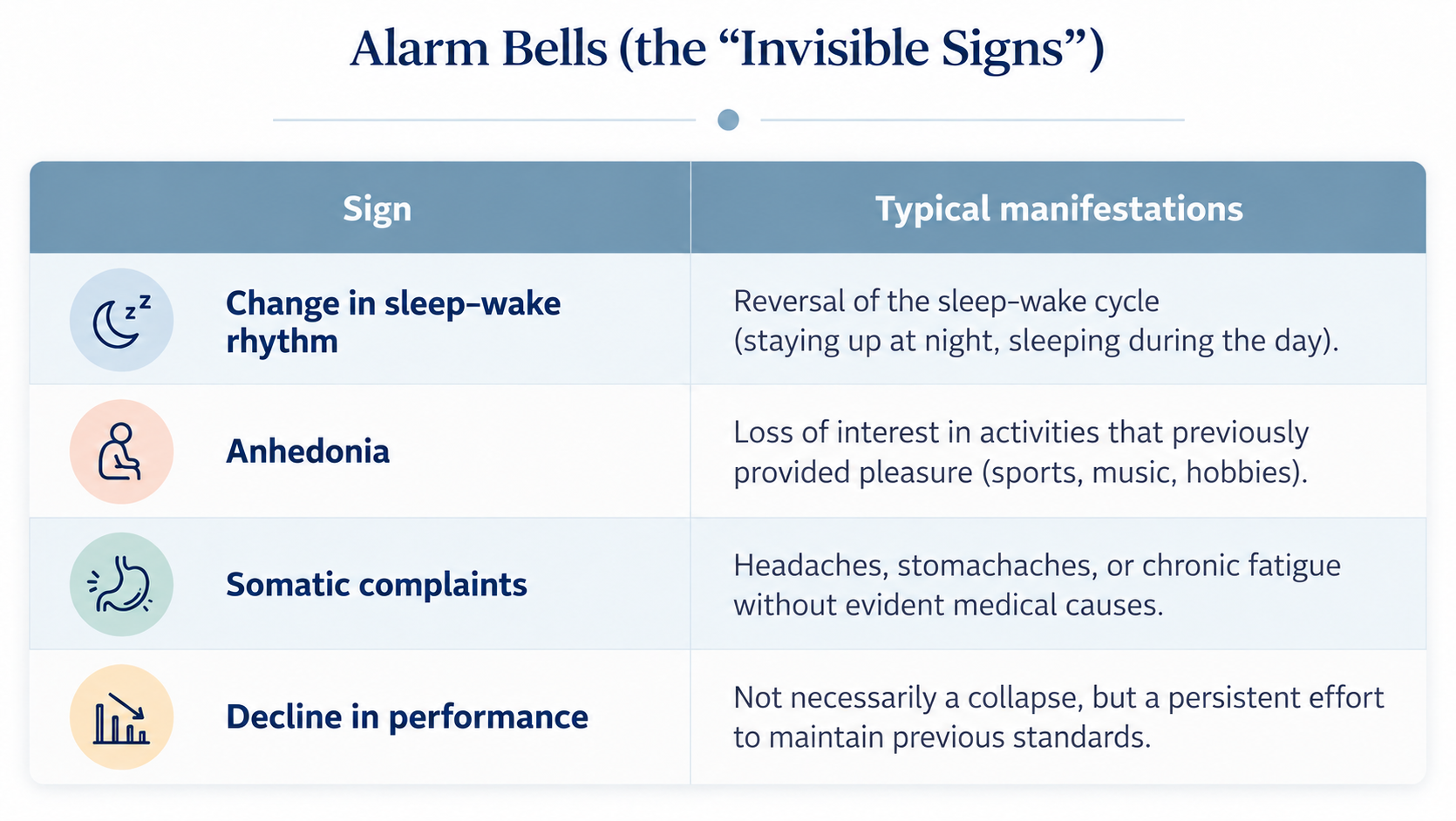
Over recent decades, the phenomenon of hikikomori has drawn attention to visible social withdrawal: young people who physically isolate themselves, shutting themselves in their rooms and discontinuing relationships and activities. However, observable withdrawal is often the final stage of a deeper, internal, and invisible process: a psychic withdrawal that precedes and underlies behavioural withdrawal.

The individual progressively distances himself or herself from shared experience, taking refuge in a self-constructed mental world in which a sense of control and identity coherence can be maintained. Without this imaginative regression, no enduring social withdrawal would be possible: the body can isolate itself only after the mind has already withdrawn.

Continue reading Psychic Withdrawal and Maladaptive Daydreaming in Adolescents and Young Adults